Scrutinizing Unemployment Rate in Malaysia and Indonesia that Affect During Covid-19 Pandemic
Keywords:
Covid-19; Unemployment; Inflation; Gross Domestic Product.Abstract
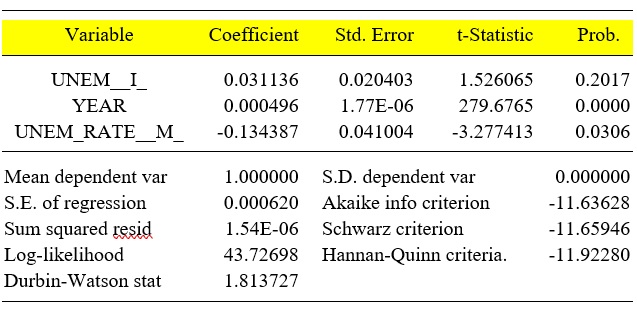
This paper examines the effects of the Covid-19 recession on unemployment on inflation in Malaysia and Indonesia from 2015 and 2022. Thus, inflation is the primary component that affects a country's Gross Domestic Product, and unemployment is one of the most important aspects of a nation's progress. Consequently, the purpose of this study is to investigate the variables that influenced the link between unemployment and inflation in Malaysia and Indonesia over the period covered by covid-19. Covid-19 is the single exposed weakness in companies that rely on heavily on-air travel and tourism, resulting in Malaysia's exponential growth. The worldwide economy and public health were affected by the Covid-19 epidemic, which led to a major drop in income, an increase in unemployment, and a decline in the transportation, service, and manufacturing industries. The pandemic negatively damaged the labour economy and prompted travel and lockdown measures. This study explores the link between two macroeconomic variables in Malaysia and Indonesia using the ARIMA model and Ordinary Least Square to examine the model's fluctuations. The model performs a regression on inflation rate variables and unemployment rate variables for the period 2015-2022. The outcome suggested that there is no correlation between the variables. The link between inflation and unemployment is affected by short-term inflation, and unemployment will be inversely proportional to an increase in one measure and a drop in the other. There will ultimately be no trade. In this study, the authors discuss their projections for the unemployment rate in Malaysia and Indonesia during covid-19, which affects inflation.