A Statistical Analysis on Labour Force Participation Rate in Malaysia for the Last Four Decades
Keywords:
Workforce; Economy growth; Industrial revolution; Time series.Abstract
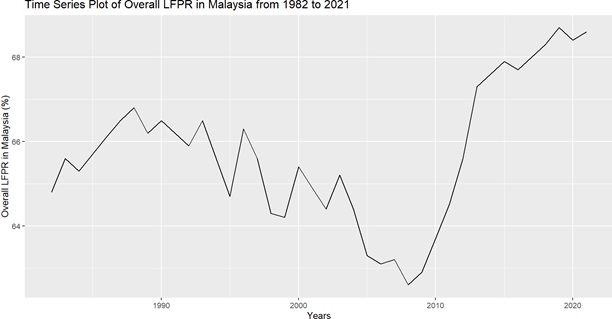
Without labour, nothing prospers. Labour force is crucial in driving a country’s economic growth as well as its infrastructure development. With respect to Malaysia’s Twentieth Plan and Industrial Revolution 4.0, the stability of Malaysia’s labour market is the key component for sustainable developments. Our focus of this study will be on analysing the trend of labour force participation rate (LFPR) in Malaysia from the year 1982 to 2021 by gender, age group, educational attainments and marital status. The data is originated from Department of Statistics Malaysia. Time series analysis and Simple Exponential Smoothing (SES) Method will be performed to forecast the LFPR for the upcoming few years. Besides, we are interested to study how different socio-demographic factors of labour force impact the overall LFPR across states and federal territories from the year 2016 to 2021 using the panel data analysis. The time series plot showed that LFPR hovered between 62% and 68% for the past 40 years and it hit the peak at 68.7% in 2019. At all time, male LFPR was significantly higher than female LFPR. It was also discovered that the demographic factors such as marital status and education level do possess different relationship with LFPR by gender. In summary, the outcomes of this study may serve as a reference for the policymakers to come up with essential decisions regarding education, training and creation of jobs for the labour market.
Published
How to Cite
Issue
Section
License
Copyright (c) 2022 AMCS PRESS

This work is licensed under a Creative Commons Attribution-ShareAlike 4.0 International License.