An Analysis of Unemployment Rate in Malaysia
Keywords:
Labour force; Economic indicator; Job opportunity; Forecast; Naïve.Abstract
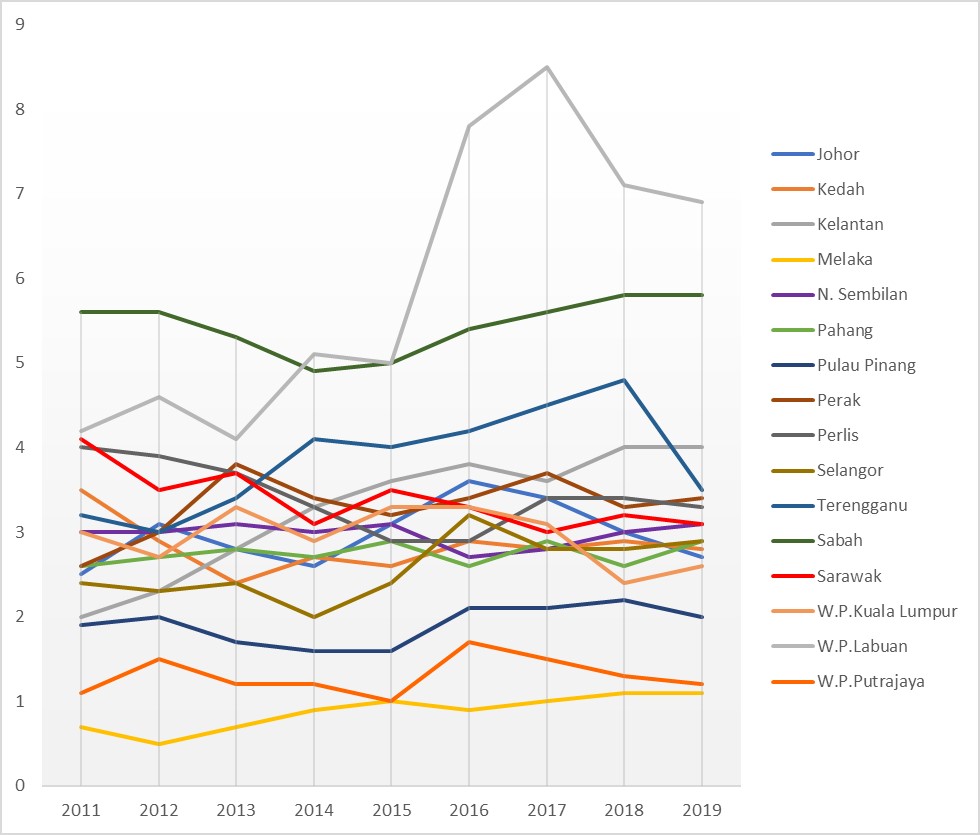
The unemployment rate is highly related to the development and the state of the economy of a country. Unemployment negatively affects the disposable income of families, erodes purchasing power, diminishes employee morale, and reduces an economy's output. The focus of this study was on analysing the unemployment rate of each state in Malaysia and making predictions for the next 5 years. The dataset was obtained from the Department of Statistics Malaysia (DOSM). An ANOVA test was performed. Results from the test showed a difference in unemployment rate among states in Malaysia where Kuala Lumpur had the lowest unemployment rate and Labuan had the highest unemployment rate. From the comparison of time series forecasting methods, Naive Method generated the lowest value of RMSE, MAE, MAPE, and MASE. This method forecasted that the unemployment rate from 2020 to 2024 was constant. Hence, the results may be a crucial indicator to the policymakers when determining monetary policy which in return, could maintain stable prices, thereby supporting conditions for long-term economic growth and minimising the unemployment rate.
Published
How to Cite
Issue
Section
License
Copyright (c) 2023 AMCS PRESS

This work is licensed under a Creative Commons Attribution-ShareAlike 4.0 International License.