
Green Synthesis of Gold Nanoparticles (AuNPs) From Cabbage Waste (Brassica oleracea L.) as Biosensors for Escherichia coli Detection in Domestic Water
Keywords:
Biosensor; E. coli; Cabbage waste; Gold nanoparticles; Domestic water.Abstract
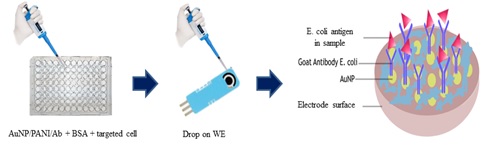
Escherichia coli O157:H7 is one of the major waterborne pathogenic bacteria and also a biodefense agent. To ensure food safety and public health, it is imperative to develop rapid methods for E. coli O157:H7 detection. In this study, we designed an innovation of biosensor based on gold nanoparticles for the rapid detection of E. coli O157:H7 in domestic water samples. Nanoparticles were synthesized using a bio-reductant from cabbage waste extract (Brassica oleracea L.) to reduce the impact that could be caused by environmental pollution due to organic waste. Gold-nanoparticles were stabilized with polyaniline and conjugated with polyclonal antibodies to formed antibody-antigen binding from domestic water samples. By measuring the amount of AuNPs through an electrochemical method with the scan rate between -1.5 V – 1.5 V, presence and the amount of the target E. coli were determined. The results showed the sensitivity of the biosensor with a linearity value of 0.9967 from a target cell concentration around 10-1 – 10-5 cfu/ mL. The resulting LOD and LOQ detection limit values are 0.8 cfu/ mL and 2.4 cfu/ mL. Compared to conventional method, this innovation reduce the detection time from 3-5 days to less than 1 hour. This research based on the AuNPs performance using bio-reductor for biosensor has potential applications in the E. coli detection and can be used to increase food/ water safety.
Published
How to Cite
Issue
Section
License
Copyright (c) 2022 AMCS PRESS

This work is licensed under a Creative Commons Attribution-ShareAlike 4.0 International License.











