
An Ergonomic Study on The Effect of Rice Plowing Activities on Farmers
Keywords:
Ergonomics; Paddy farmers; ERA; RULA; DHM.Abstract
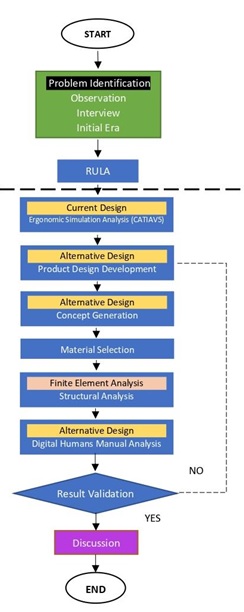
This research indicates the effect of paddy farmer's health and safety being a primary issue in order to provide appropriate operating capability to fulfill production interests. The purpose of this study is to determine the ergonomic effect of ploughing machinery power tiller transportation on the farmer's body while spraying soil, creating water channels, and cultivating the soil in paddy fields. The respondents for this study consists of 10 active male paddy farmers. The ergonomic risk evaluation was conducted using the standard ergonomic form, such as the Cornell Musculoskeletal Questionnaire, initial Ergonomic Risk Assessment (ERA) investigation, Rapid Upper Limb Assessment (RULA) method, Digital Humans Modelling (DHM) and experimental procedures for vibration analysis using the accelerometer sensor. Based on the RULA worker’s assessment worksheet, it was found that the most affected body parts of the paddy farmers are the shoulder, hand/wrist and lower back. For all postural angles, the RULA score for the proposed-on new design of power tiller force bending and back pain was decreased. This is because the awkward posture compels paddy farmers to elevate their arms, shoulder, hand/wrist and lower back causing discomfort in a specific area of their body and so lengthening the required exposure period. The results clearly show that as the vibration on the power tiller handle is reduced while using rubber as the vibration damper, both the voltage in time domain and the acceleration in frequency domain results drop significantly, with reduced oscillatory motion and the use of absorber as the control mechanisms.
Published
How to Cite
Issue
Section
License
Copyright (c) 2023 AMCS PRESS

This work is licensed under a Creative Commons Attribution-ShareAlike 4.0 International License.











