Quality Control Analysis to Reduce Product Defects During the Cutting Process with Six Sigma and FMEA Methods
Keywords:
DMAIC; FMEA; Quality Control; Six Sigma.Abstract
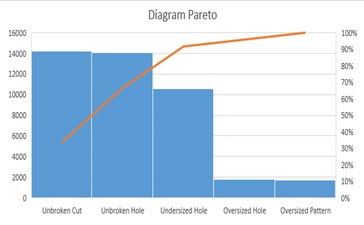
Named as XYZ Ltd. which operates in the automotive industry and places a high priority on the quality of its products by routinely conducting quality control procedures. One of the products manufactured is car seat covers made with textiles created directly by the manufacturer and containing 6,29% average product defects per period. The implementation of this study delivers important application and results that can be deployed in this manufacturing company. This study aims to establish if defects in car seat cover items have been controlled and to identify the predominant types of defects. There were unbroken holes, unbroken cuts, undersized holes, oversized holes, and oversized patterns noted. This research prioritizes improvement targets using Six Sigma and FMEA. With the Six Sigma method, the DPMO value is 12407 and the Sigma value is 3.74. According to the findings of this study, the most significant sort of defect is unbroken cut, accounting for 33.50% or as much as 14,193 pcs, with an improper process being the primary reason. Improvements with FMEA, the unbroken cut with an unmatched machine type had the highest RPN. Thus, preventive steps are required to ensure that the product transferred to the subsequent procedure is high quality.
Published
How to Cite
Issue
Section
License
Copyright (c) 2023 AMCS PRESS

This work is licensed under a Creative Commons Attribution-ShareAlike 4.0 International License.