Effect of Rural Infrastructure on Household Poverty in Oyo State, Nigeria
Keywords:
Effect;, Household poverty;, Rural infrastructure;, Nigeria.Abstract
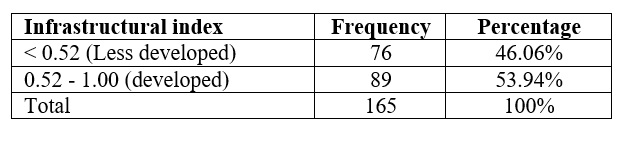
Low infrastructural investment in many rural areas have hindered economic development. Given that, poverty assessment towards SDG2 and the contributory role of infrastructure is key to national development, this study examined the effect of rural infrastructure on household poverty in Nigeria. A multi-stage sampling technique was adopted and using Cochran’s formula for infinite sample sizes, 170 rural farming households were surveyed using structured questionnaire. Methods of data analysis were descriptive, Foster-Greer-Thorbecke measure, infrastructural index and Tobit regression model. The mean age and years of formal education of household head were 53.00±12.74years and 8.14±7.54years respectively, the mean household size was 6.26±3.29 and majority (86.06%) of the households have no other occupation but farming. The poverty line was NGN9,011.85 with 52.12% of the households being poor and 47.88% being non-poor. With a 0.52 cut-off point in infrastructural index, 53.94% of the households resided in relatively developed areas while 46.06% resided in less-developed areas. Infrastructural index was negatively significant to poverty gap of households, suggesting that government and its partners should intensify provision of infrastructure particularly in rural areas.