Physical and Mechanical Properties of Particle Boards from Sugarcane Bagasse Waste (Saccharum officinarum) and Tobacco Stems (Nicotiana tabaccum) Made through Soda Process
Keywords:
Particle board;, Sugarcane bagasse;, Tobacco stems;, Soda process.Abstract
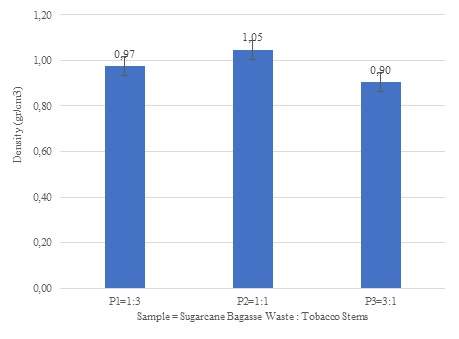
The availability of wood has not been able to meet the increasing industrial capacity. A several community widely uses an alternative for solid wood, namely particle boards or artificial boards. The process used in the manufacture of composite waste-based particle boards is the soda process with the addition of NaOH where there is delignification which will open the lignocellulosic structure so that cellulose becomes more accessible by dissolving lignin content in the material so that it facilitates the process of separating lignin from fiber. The aim of this research is to find out the physical and mechanical characteristics of particle board in accordance with the standards JIS A 5809-2003 and the best formulation of alternative wood substitutes. The research method was factorial CRD (Completed Randomized Design) with a combination of different ingredients compared to bagasse and tobacco stems (1: 3; 1: 1; 3: 1). The results showed that the physical density test resulted in a value of 0.89-1.05g / cm3, a thickness of 6.63-7.63 mm, a moisture content ranging from 9.81 to 12.14%, and a thickness development of 4.37-6 26%. The mechanical properties of particle board that is equal to 157.92-271.58 kg / cm2 for Modulus of Elasticity/MOE and Modulus of Rupture/MOR values are 221.11-881.87 kg / cm2. These results indicated that the particle board physical tests had met the standards of density, thickness, moisture content, and thickness development. While the mechanical properties of the flexural strength test or MOE did not meet the standard, the fracture constancy test or MOR met the standard.