
Runoff Rainwater Response Experiments to Reduce Urban Floods with a Scale-based Model
Keywords:
Flood control; Green infrastructure; Rainfall Simulation; Runoff.Abstract
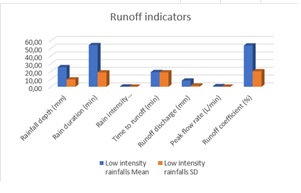
In this study, a typical urban surface has two green infrastructures (submerged grass and porous pavement) and two precipitation intensities (low intensity), 0.dua mm/min, 25.3 mm depth, high density, 0 mm, five flow behavior (1.0 mm) and the effect of permeable surface location and initial soil moisture content on process runoff. The results showed that the unblown concrete surface flows faster with a flow coefficient of 89%. The flow time in the grass area is about 25 times that of the impervious area, the minimum flow coefficient is 53.0 mm, and the maximum flow coefficient is 67.0%. Compared to impervious areas, submerged turf can effectively delay water flow time, while porous pavement can greatly reduce flow and peak flow. Excessive precipitation shortens runoff periods, increases runoff, and increases runoff. The permeable surface below the lower surface produces a slower flow and has a lower coefficient of permeability than the permeable surface below the upper surface. There was a significant negative correlation between initial soil moisture and runoff time, and a positive relationship between initial soil moisture and runoff coefficient. The findings help to better understand runoff processes on urban surfaces, and green infrastructure can help design better hydrological systems to reduce urban flooding.
Published
How to Cite
Issue
Section
License
Copyright (c) 2022 AMCS Research Center

This work is licensed under a Creative Commons Attribution-ShareAlike 4.0 International License.











