
Placemaking in the Jogokariyan Mosque Area, Yogyakarta
Keywords:
Solid identity; Jogokaryan community; Placemaking process; Social, Economic; Cultural activities.Abstract
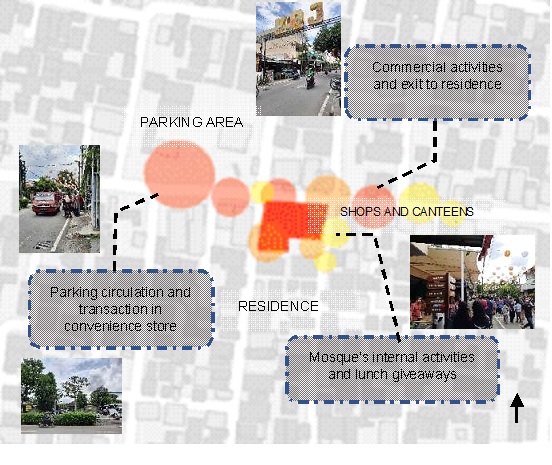
The Jogokariyan mosque area in Yogyakarta is known as a Muslim area with a lively religious public space. The life of this area is driven by the management of the Jogokariyan mosque in maximizing the function of the mosque as a religious public space that practices the concepts of habluminnallah and habluminannaas, namely as a place of worship for Muslims who practice ritual and social value activities. The practice of this activity is carried out inside and outside the mosque so as to create placemaking that involves worshipers and the wider community. This study aims to examine the placemaking process that occurs with qualitative descriptive methods. Data were collected by means of observation and interview. The data then analyzed by means of activities mapping. The results of the study found three main points of the placemaking process that made this area sustainable. The first is the existence of a solid Jogokariyan community identity with the support of the mosque's "key persons". Second is the growth of follow-up activities that are social, economic, and cultural in nature that strengthen the spirituality/motivation/psychology of the community. Third, this activity becomes an external stimulant for the surrounding community through routine and incidental communal activities.
Published
Issue
Section
License
Copyright (c) 2023 AMCS PRESS

This work is licensed under a Creative Commons Attribution-ShareAlike 4.0 International License.











